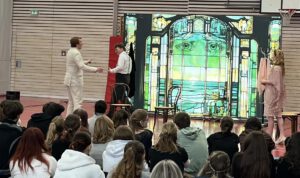
Before the holidays on Friday, February 6th, 2026, our class, together with a few classes from Gymnasium Rudolstadt, watched the play The Great Gatsby. We did not go to a traditional theatre. Instead, the play was performed by the well-known English theatre group White Horse Theatre in the gym of the Fridericianum Rudolstadt, which was interesting to see because the sports hall was transformed into a proper stage for the performance.
The story follows Jay Gatsby, a wealthy man who throws extravagant parties in the hope of reuniting with Daisy, the woman he loves. The play explores themes such as love, dreams, and how money can influence people.
The photo shows a scene from the performance. Many students are sitting on the floor, watching carefully. On stage, there are three actors: on the left, Gatsby is wearing a light-coloured, elegant suit that perfectly fits the 1920s style. He is shaking hands with Tom, who is standing in the middle wearing a shirt and dark pants. On the right, Daisy is dressed in a soft, light-coloured dress from the same era, watching the two men. In the background, a large, colourful window featuring big eyes—a key symbol in the story—is part of the stage design. The stage also has two simple chairs, and the overall scene captures an important moment in the play.
One of the play’s strongest points is its atmosphere. The combination of costumes, music, and set design beautifully conveys the glamour of the 1920s. The actor playing Gatsby convincingly portrays his charm and deep love for Daisy, which makes the audience feel sympathy for him. However, there are some weaknesses. Certain scenes feel a bit slow, and Daisy’s character could be developed more to make the love story stronger. At times, it was slightly confusing because some actors played two roles simultaneously.
There were four traveling White Horse actors who played the different roles. They had only a few props, including glasses of alcohol, clothes rack, obsolete telephones, a chair, a weapon, the mosaic-style stage design with green, ocean-like elements and the iconic eyes. Despite the limited equipment, they created an engaging performance that captured the essential interactions and emotions of the story.
Comparing the play to the book and the film, some differences are clear. Unlike the movie, which has a higher budget and faster pacing, the play relies more on imagination and emphasizes character interactions over detailed settings. The film makes it easier to follow the story quickly, but it is less personal than the play, where the chance to ask questions to the actors at the end adds a more intimate and familiar experience. The book, freely accessible online, remains the most accurate portrayal of the story.
Overall, the theatre performance was a great experience, and we would recommend it to other students. While it was a bit cheap in terms of props, the actors’ energy, the convincing atmosphere, and the transformation of the sports hall into a 1920s stage made it memorable.
Class BGYW25